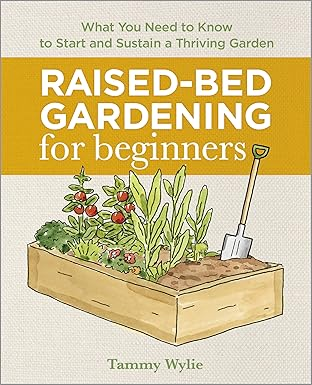
Raised-Bed Gardening for Beginners: Your Guide to Growing Sustainability and Self-Sufficiency
$7.00
Grow your own food with the ultimate beginner’s guide to raised-bed gardening!
Are you interested in creating a bountiful, sustainable garden at home but aren’t sure where to start? Try a raised-bed garden!Raised-Bed Gardening for Beginners shows you how simple it can be to plan, build, and grow your own high-yield, above-ground garden, even when space is limited. With this clear and easy starter guide, you’ll learn how to build the beds, mix and maintain the soil, choose the right plants, and keep them happy, so you can have fresh vegetables, herbs, and more, grown right in your own backyard!
Green thumb 101― Get answers to common gardening questions like when to plant, whether to use seeds or seedlings, how to handle plant pests and diseases, how to arrange your plants, and so much more―no experience required!
Garden friends and foes―Maximize your crop yield with tips for companion planting that explain which plants grow even better together and which will compete for space and nutrients.
30 plant profiles―Find full stats on 30 different beginner-friendly plants such as onions, spinach, potatoes, squash, and more that explain each crop’s sun and soil needs, seasonality, common pitfalls, and how to harvest them.
Start (or expand) your collection of gardening books and get growing fast with this complete guide to raised-bed gardening.
Get growing fast with this complete reference for raised-bed gardening, and the other books in the series, including Homesteading for Beginners and Container Gardening for Beginners.
Read more
13 reviews for Raised-Bed Gardening for Beginners: Your Guide to Growing Sustainability and Self-Sufficiency
Add a review
Related Products

$7.00

Bezelthia –
I am shortly moving to a smaller home with small garden and plan to have raised beds. This book has all the information that I was looking for and has inspired me to follow through when we have moved,
Nikki –
If you believe that gardening is too much work, or that you didn’t come to Earth with a green thumb, this book is for you. Read it, spend a little time and effort planning, and your garden will grow fruitfully. Tammy Wylie’s Raised Bed Gardening for Beginners book contains just enough information to keep it a one-weekend project, with well-spaced words and illustrations that make new concepts easy to comprehend. It truly is Everything You Need to Know to Start and Sustain a Thriving Garden.
Raised Bed Gardening for Beginners: Everything You Need to Know to Start and Sustain a Thriving Garden, ISBN 978164152509, was written by Tammy Wylie and published in 2019 by Rockridge Press in Emeryville, California. The author has gardened since she was a small child, and also created the blog Grow Your Own Food…Anywhere. Its list price is $14.99 USD, though it can be bought on Amazon for $13.29. It is worth buying a physical copy as it is one of those books that is lovely to hold. It has soft, smooth covers and 120 thick, colorful, square pages. There is also plenty of space for writing notes.
After receiving this book, I first read it from beginning to end before purchasing garden supplies. I have previously attempted a small, raised bed garden that I started without any knowledge or research. It was interesting to learn what can be done to promote growth and sustainability, and to see where I had previously erred. The most helpful takeaway was the importance of planning before planting. With the knowledge gained from reading this guide, I actually enjoyed thoughtful planning. I then purchased a 4’x4’ wooden garden frame from Home Depot, 6 large bags of soil, and seeds for the plants I decided to grow. Using this guide, I built and planted my garden, and now, as of 3 weeks later, there are growing plants visible in all of the sixteen, 1 sqft. plots.
I have two favorite parts in this book. First, on pages 10-11, there is a chart that explains how various plants work together. The “Plant Friends and Foes” chart is a clear, useful guide to plant compatibility for beginners. For example, it lists lettuce with carrots as a friend and cabbage as a foe. It further explains, “Lettuce has shallow roots; carrot roots grow deeper in the soil. They do not compete with each other for space.” This is the first I had heard about plant compatibility and I have enjoyed using it for planning and doing further research. As more time passes, it will be interesting to see how these plants survive. The second part of the book I really enjoyed reading were the Plant Profiles. Each plant featured is allocated two side-by-side pages. The entire background of the left page is a crisp, vivid close-up photo of the plant. There is a neutral colored box with the plant family name, growing season(s), USDA hardiness zones, spacing needs, and time from seed to harvest. It also includes when to start seeds indoors, the earliest outdoor planting, and the watering needs. The right page contains the plant’s common name as well as its scientific name and an interesting, helpful tip. For Basil, it suggests, “Try growing the large-leaf basil for making wraps and purple basil for creating a focal spot in your garden.” The right page also includes detailed information for starting, growing, and harvesting, as well as problems you may encounter and how to mitigate. The “Starting” section is helpful to know how much sun and/or shade is required, as well as how deep to plant the seeds. It had not previously occurred to me to pay attention to the depth of seed planting.
I would advise reading about USDA plant hardiness zones and finding the relevant zone before starting to read the book. While Chapter Six: Plant Profiles is one of my favorite sections, I would add upfront that all mentioned plants can be grown in zones 3 through 10, except asparagus which is best suited for zones 3 through 8. This information is not summarized, but rather spread out over 60 pages and caused additional, unnecessary work while planning my garden. It is only upon review I realized I did not need to constantly flip back and forth to check the zone. If this information were mentioned earlier in the book, it would be easier to discern which plants are available to the reader or not.
The only part of the book that I did not find interesting to read, but rather tedious, is Chapter Three: Soil. It promptly states, “Soil quality is as important to the quality of your raised-bed garden as sunlight and water.” I sense the author knows it is not a particularly gripping topic. Fortunately, it is a short chapter that explains soil quality considerations and how they can impact the results of your garden. It also explains how to calculate the amount of soil you will need, and how to mix and maintain the soil. It also provides information on how to test your soil. Full disclosure, I did not use this information in my planning or planting and expect to learn that these are necessary details. I purchased Kellogg Garden Organics All-Natural Raised Bed and Potting Mix soil from Home Depot and am hoping that is a one-size-fits-all type of soil. If my garden yields poor results, I will further investigate the soil.
Overall, I would highly recommend this book to anyone interested in starting their first small garden. It is great for visual learners who are more inclined to understand and remember images and diagrams. It is an aesthetically pleasing book with easy-to-follow instructions. I successfully started a garden in my backyard using this book, and I am also using it to start a small community garden at my church. This guide has enabled me to create planning charts and consolidate information into reference sheets for the group members.
Mo –
This book is going to be a Christmas gift for a new gardener.
It looks as if it will be a great help .
Young Adult –
I got so much out of my garden in my first year! This book was a great way to get a base understanding of your vegetable garden before you begin. I would suggest also using the “Planter” app to help plan out your plot.
Angazi –
Useful introduction to the “how-to” concept of raised bed gardening, not too US-centric, still very applicable in an SA context. It has 1-2 pages per topic, with hand drawn illustrations and some photos to explain things in a succinct and certainly not overwhelming detail (but enough to get going). Hardly covers anything on pests or diseases, but for setting things up, getting started with your first crops planted its written in a non-intimidating matter for you to feel comfortable getting your feet wet with the basics.
Judy Carol Faust –
I’m enjoying this little book a lot so far. I love the simple and colorful layout, and I feel encouraged to try raised bed gardening again after many decades. I live in an apartment so having a compost pile had to be thought out. Luckily, I can buy a counter top electric compostor which takes little space and will make great soil and fertilizer. It will be so nice not to have smelly bags of garbage to drag to the distant trash. We can have raised beds here so I’m so excited to grow some of my own food.
Crynker –
Great book! I am a seasoned gardener and still found this so helpful. Short and sweet, but chock full of valuable information! I went back and bought a second one for my sister-in-law!
Sofia A. –
I read the entire book, it had some good information, but failed to recommend good fertilizers or a proper fertilizing schedule for each plant.
Not to mention there was no mention of what to do when ur plant begins to flower. If you don’t have a lot of bees, you must hand pollinate which is not talked about at all in this book. Information was very basic and I didn’t like that the author uses the miracle grow fertilizer.
It’s very chemical based and that goes into your body when you use miracle grow fertilizer on ur crops. Fish fertilizer is much better and it’s more natural.
jessie williamson –
great pictures, has good basic skills ,good to have and look up what plants can go together too
Cliente123 –
Muy bueno, todo lo que necesitas saber para poner un jardín de hortalizas en casa. Lo recomiendo ampliamente
Matthew Rivera –
This book is exactly what I was looking for for a quick reference to plants , friends and foes . It also has information on soils structures and harvesting
Kayla –
Great book for someone learning the basics of raised bed gardening. After a year of using this book as a guide for my raised beds, I’ll likely pass it on to another beginner gardener.
birdie –
Easy, practical gardening advice