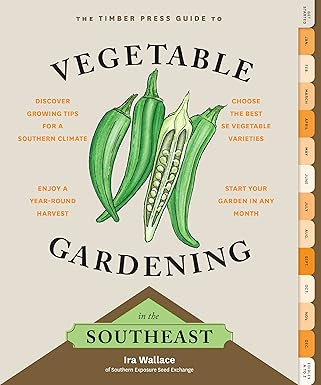
The Timber Press Guide to Vegetable Gardening in the Southeast
$27.01
How to grow your own food in the Heartland!
There is nothing more regionally specific than vegetable gardening—what to plant, when to plant it, and when to harvest are decisions based on climate, weather, and first frost The Timber Press Guide to Vegetable Gardening in the Southeast tackles this need head on, with regionally specific growing information written by local gardening expert, Ira Wallace. Monthly planting guides show exactly what you can do in the garden from January through December. The skill sets go beyond the basics with tutorials on seed saving, worm bins, and more.
This must-have book is for gardeners in Alabama, Arkansas, Florida, Georgia, Kentucky, Louisiana, Maryland, Mississippi, North Carolina, South Carolina, Tennessee, Virginia, and West Virginia.


AC –
This is a comprehensive guide to growing vegetables in the southeastern quarter of the United States. As an experienced gardener, most of the information is not new to me, but there were a few nuggets that will make a difference in my planting and cultivation practice.
The first section contains a wealth of general information about gardening. I’d never heard of the AHS Plant Heat Zone Map, which can help gardeners avoid having their plants suffer from excessive summer heat. Another helpful concept was phenology–the observation of nature as a guide to planting and predicting insect emergence. For instance, if you plant beans when lilacs are in full bloom, the soil will be warm enough to help them grow.
Following the discussion of the basics, there’s a section with garden tasks to do in each month of the year, with additional useful details. The Southeast, as defined by the author, is so large that if you live along the borders, or in in the Appalachian mountains, you may need to adjust the dates somewhat. I live at the extreme northern edge of the area, and the microclimate of my back yard is cooler than my neighbors’. I’ve found I need to do most of my spring planting a little later than this book would lead a new gardener to believe.
Next comes a long list of plants a home gardener might grow for food, with information about growing, harvesting, choosing the right variety, and saving seed. If you can’t find something you want to try here, then a vegetable garden isn’t for you.
Finally, there’s a list of resources, a glossary, and an index–truly necessary since much information is given month-by-month.
My first gardening book was “Crockett’s Victory Garden.” With its chatty style, glossy photos and information on how to create a productive garden out of a parking lot, it got me started on the right path when I was a new gardener. “Crockett’s” is still my favorite for sentimental reasons, but Ira Wallace’s book comes close.
Library Card Homeschool –
This is a wonderful resource and one that I am so glad I purchased! I just wished I would have purchased it this exact time, last year. We are new to the Deep South, having been here almost a full year now. Had I purchased this in Nov 2014 when I knew this is where we were coming, I would have saved myself some serious time and heartache. I was still used to the Northern time line although I adjusted mine by about two months (planting in April vs June). It was still 3-6 months behind and thus, I lost most of my garden. Unfortunately, I also spent $$$$ on heirloom and rare varieties and all but a small handful were productive. Lesson learned.
This book is laid out according to months and it gives you a Cliff Notes version of a list on the first page of every chapter (month) of what to do this month. It adjusts the timeline for Northern South and Deep South as well as a guide for those in between. I have learned with this book that the summer months are my new “winter”. Very few things that my family’s taste buds enjoy will produce during those 3-3.5 months. Again, a major time and money saver had I know this up front. I’ve been able to get my garden in order now (November) so that my seedlings are ready to be planted in Jan which is a very new idea to me. Everything my fruits like grapes and berries to herbs, garlic, root crops, greens, etc can be found here. I could look up the info online or via the county extension office as to what to plant and when, but this book does a far better job with the details than any of the sites I looked last year. The author also understands that many of us like organic gardening and are fans of heirlooms. She herself, runs a seed company that sells heirlooms. I was able to purchase heirloom GREEN cotton seeds! A rare find, indeed!
If you like full color, glossy pages then this is not the book for you. Most of the text is dark brown on tan pages which might be a turnoff for some. I would purchase this book again should anything happen to my copy. I’ve been using it a lot in the past week to plant my heirloom garlic varieties and soon, heirloom storage onions.
L. –
The only thing I wish this book had was a month by month calendar to flip to for what to do each month by region. It is organized by ‘after the last frost’ and other such ways of planting, but I think it would be so much better if it gave a ‘by region’ to do list for each month separately so I could just look at which month I’m on.
I have to write a whole journal just to get what I need from the book, so it would be awesome if it had contained a section in the back that helped out by month.
Otherwise, still a good book with lots of helpful suggestions about gardening. It just wasn’t what I thought I was getting when I saw the monthly tabs on the side of the front of the book.
Ttge –
I am new to gardening and this book is helping me to be very successful. I garden in zone 9a and I was having a hard time with different diseases on my veggies and this book gave specific varieties to grow in my zone. Being new I definitely needed those recommendations. The month by month breakdown comes with clear and easy directions that even I can understand. I have referred back to this book several times throughout the growing season