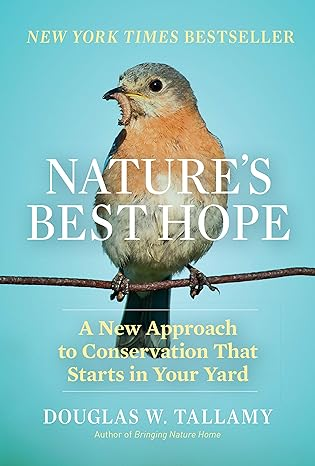
Nature’s Best Hope: A New Approach to Conservation That Starts in Your Yard
$14.00
From the New York Times bestselling author of Bringing Nature Home comes an urgent and heartfelt call for a new approach to conservation—one that starts in every backyard.
Douglas W. Tallamy’s first book, Bringing Nature Home, awakened thousands of readers to an urgent situation: wildlife populations are in decline because the native plants they depend on are fast disappearing. His solution? Plant more natives. In this new book, Tallamy takes the next step and outlines his vision for a grassroots approach to conservation. Nature’s Best Hope shows how homeowners everywhere can turn their yards into conservation corridors that provide wildlife habitats. Because this approach relies on the initiatives of private individuals, it is immune from the whims of government policy. Even more important, it’s practical, effective, and easy—you will walk away with specific suggestions you can incorporate into your own yard.
If you’re concerned about doing something good for the environment, Nature’s Best Hope is the blueprint you need. By acting now, you can help preserve our precious wildlife—and the planet—for future generations.
“Tallamy lays out all you need to know to participate in one of the great conservation projects of our time. Read it and get started!” —Elizabeth Kolbert, Pulitzer Prize-winning author of The Sixth Extinction
Read more
9 reviews for Nature’s Best Hope: A New Approach to Conservation That Starts in Your Yard
Add a review
Related Products

$14.00

Mike Barnett –
Professor Tallamy has a vision for our future that you need to read about. Imagine a world (I’m borrowing from his eighth chapter now) where you may look out of any window in your house and see a view of a national park, filled with wildlife and the vegetation that makes up their natural habitats. This is Tallamy’s call for all of us to consider our properties as potential habitat for the birds, insects, and other critters that have been consistently misplaced by our yards. So what does he claim is “Nature’s Best Hope?” It is plants native to our region, not the exotics we so often plant that can’t be used by our native insects. It is then the native insects that so many birds and animals feed upon and serve to their young. It is then the native birds and animals that eat the insects, and from there the animals that eat them. “Nature’s Best Hope” is returning our neighborhoods to as natural a habitat as we can make it after the bulldozers have left. It’s giving back to our fellow inhabitants a place where they can live, grow and reproduce. It’s returning as much of our property to a natural state as we comfortably can for their benefit. WE, then, are “Nature’s Best Hope.” This is something we all have the power to do. And Tallamy tells you how you can do it in simple steps. I’ve done it, so you can, too. His ideas work!
And he doesn’t hate exotic plants, some have their uses, so you need not remove them all. He’s not that extreme. But he does know the benefits of our native plants and tells us how they work for our native ecology. Comparing natives to exotics, he guides us in the right choices for our landscapes.
And it doesn’t have to look like a jungle (unless, of course, you already live in the jungle). Tallamy gives lots of advice on ways to create visually aesthetic yards, something to be proud of, as well as something ecologically helpful. In short, he calls this a “home-grown national park,” where nature is simultaneously preserved and enjoyed by people. Picture that right there in your own neighborhood, in your own yard! A place where the kids can walk out the door, explore and learn about nature without driving 300 miles to the nearest park!
And, come on, who likes mowing the grass anyway? (I know there will be a few hands raised on this one as it does take all kinds to make a world). But to be fair, Tallamy doesn’t advocate total elimination of grass from your yard either. Just include some natives in your landscape for the creatures that depend upon them for their very survival. Leave the grass wherever you want to: it handles foot traffic fairly well. But recreate some natural habitat for the things that need it, like butterflies, ladybugs, birds, bees and other pollinators. Then, of course, you will begin to realize who really needs healthy natural habitats. The creature we are all the most fond of: us! If the habitats we live in aren’t fit for the bees, they ultimately aren’t fit for us either! Tallamy says this better than I have. His book is eloquent, articulate, and convincing. Read it now, for your own benefit.
Pattee Fletcher –
Nature’s Best Hope: A New Approach to Conservation that Starts in Your Yard. Douglas W. Tallamy (2019).
This book should be read by everyone; it is an essential blueprint to put into action today if we hope to sustain, restore, and conserve our environment. Tallamy states in no uncertain terms that conservation efforts in the past are not sufficient. One, because the parks and preserves of the past, while good efforts, are too small an approach to remediate our current situation. He asserts that everyone has to be involved in conservation actively, at home, at work, in our communities, where we farm, in our front yards. Our second misstep is that of assuming that scientists and conservationists were enough to stem the tide of destruction we have loosed upon our Earth. Everyone is responsible for the conservation of our Earth, stewards one and all.
Tallamy makes a compelling argument for individual responsibility for conservation. Providing factual data and our history of caring for the Earth, he creates a living, breathing scenario that is profoundly engaging – yet, at the same time not hopeless nor insurmountable. His love for the Earth is readily apparent in his ideas and his words; a summons for all to respond and remediate.
As he states, “This book is about fixing problems’” and he demonstrates how the problems are fixable. Tallamy offers solutions anyone who has a piece of land can implement, whether reducing the size of our lawns or enabling weeds to flourish when they are native and essential to the ecosystem. His chapter on restoring insects is a call for all of us to no longer think in terms of a ‘bad bug’ but rather, to view insect life as essential to the life cycle. He challenges us to think of ourselves as conservators of ‘homegrown national parks.’
Personal anecdotes, historical wisdom, and illustrative color photos pepper the pages, creating in the reader a selfish interest in this topic. His writing is familiar and clear; we need not be ecologists to understand the criticality of the problem nor the potential array of solutions he proffers. Read this book
CC –
Very informative, if you live in the USA.
Zack –
Douglas breaks everything down into plain English for anybody to understand, you don’t have to have any knowledge on the subject to understand his writings and message. It is a must read for any person interested on how they can do better with their own property truely no matter the size. It is non-political and jammed packed with shocking facts about the world going on around you that no one’s talking about
James M. –
I can’t say enough great things about this book. Broad takeaway: you can make a difference. Live in an apartment? You can put out plants for birds, bees and butterfly’s. Office job? Same thing in your outdoor areas. On an on. This helps give you real tools, real info, and real reasons we should all be doing this. These animals literally help keep us alive. I don’t want to sound like a nutter, but that’s the truth. No more bees, no more humans. Period. His writing is easy and informative for what is a difficult subject. We should all be thinking of our yards as “stopping points” or “places of refuge” for these little critters. Use less stuff to kill the bugs. Make more places for them to thrive. Excellent read. I’ve given away at least a dozen of these books and always to rave reviews and not just to granola munching tree huggers. This applies to everyone.
amcl –
This book opened my eyes – a very good read and necessary for moving forward in the future and supporting our natural environment.
Solodiver –
Nice book on alternative land use and getting away from sparkling chemical laden green lawns. Four years ago I moved from Calgary to a small village in Saskatchewan. Bought a modest bungalow on a monster lot that needs constant maintenance. After reading this book I added a natural pond and allowed most of my backyard lawn to grow wild.
Florida Becky –
This is a great book. The author is passionate about the importance of everyone taking manageable actions to help nature thrive in our little pieces of Earth, and he offers simple suggestions for doing so. The references are vast within the text, and the information is fascinating. It’s a book any nature lover will welcome. I plan to share with several friends/family to help spread the word.
ColourMeGone –
Doug Tallamy is a wonderful writer and knowledgeable author on his topic. His videos are great to see too.